Officials May Not Be in the Trenches — But Their Sons Should Be: What Real Justice During War Looks Like
For over a decade, Ukraine has been living through a war — one that has evolved into a full-scale Russian invasion. As the country moves from shock to heroism and eventually exhaustion, public demand for justice grows louder. One of the most pressing issues is the fairness of conscription and the duty to defend the homeland. The popular sentiment goes: “Send all the MPs, police, and government officials to the front!” But would that really solve the problem?
An alternative view suggests the problem lies not in the official’s physical absence from the trenches, but in their psychological and social distance from the war — a distance made possible by the protected status of their families.
The Roots of Public Resentment
Public anger toward the authorities doesn’t come from nowhere. It’s rooted in a deep sense of inequality. Ordinary citizens bear the full burden of war: mobilization, personal loss, economic hardship. Meanwhile, some officials and their families seem able to evade these hardships altogether. This creates a dangerous sense of betrayal — when defending the country becomes a responsibility for “some,” not “all.”
People start asking bitter, painful questions: “Why should I go to the front when politicians don’t fight?” or “Why should my husband, son, or brother risk his life while the police sit safely behind desks, collecting salaries?” These are not just complaints — they become a moral justification for reluctance to serve. But is this frustration valid? Let’s dig deeper.
The Role of Civil Servants During Wartime
Demanding that all MPs, judges, and government employees be sent to the front reflects a misunderstanding of how a modern state functions. Wartime governments must continue to operate — ministries, courts, law enforcement, logistics systems, and foreign aid coordination all remain critical.
If these institutions collapse due to a mass exodus of qualified personnel to the front lines, the result could be catastrophic — potentially even more so than a military defeat. The real issue isn’t whether they’re in trenches; it’s whether they feel the war, whether they act as though it affects their own families.
The Real Problem: Privilege and Protection of Officials’ Families
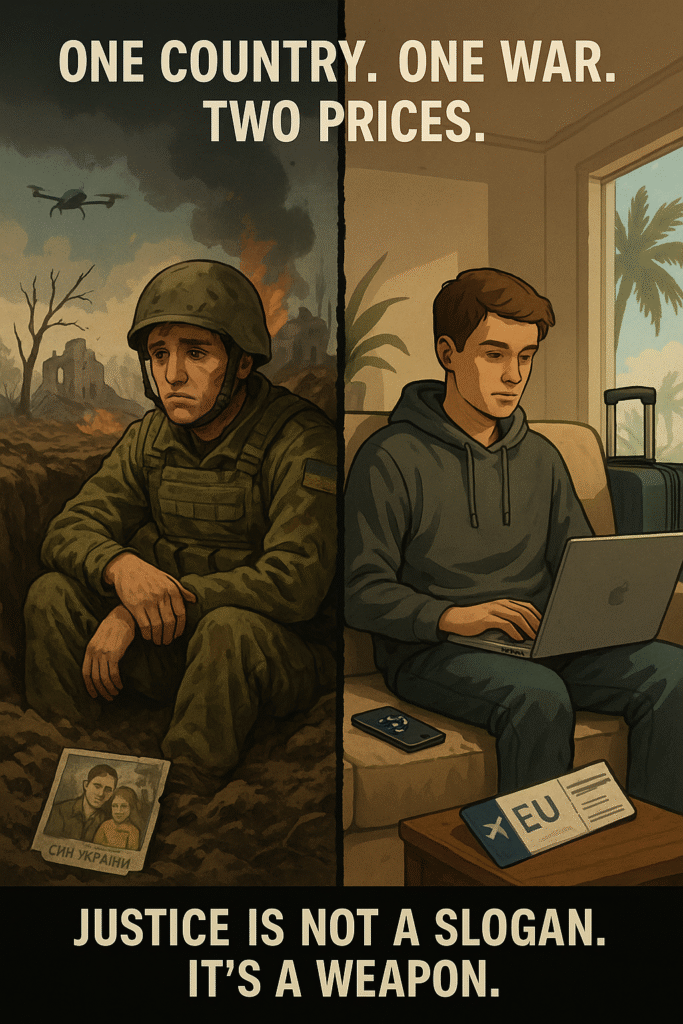
The true injustice lies not in where an official works, but in the immunity enjoyed by their relatives. When the sons and daughters of Ukraine’s elite study abroad, live luxurious lives, and evade conscription — either legally or thanks to connections — while ordinary families lose their fathers and sons in battle, the injustice becomes intolerable.
These are not abstract claims; society is well aware of specific cases (even without naming names). And such cases undermine any call for unity or shared sacrifice.
A War That Feels “Foreign” to the Elite
This disparity creates a psychological chasm. For an official whose family is untouched by war, conflict becomes something distant — measured in casualty reports and budget allocations. It becomes an abstract challenge, not a lived reality.
Such detachment leads to sluggish, bureaucratic decision-making — whether it’s the delivery of weapons, medical support for the wounded, or preparation of reserve units. Officials focus on projects that offer personal gain, not on those that would lead to victory. For them, the war is a “challenge,” not an existential threat.
Personal Stakes Drive Urgency
History shows that when leaders are personally invested — when their children are on the front lines — everything changes. Leaders like Truman and Eisenhower, whose sons fought in World War II, understood war differently. The fear for a child’s life breaks through bureaucratic numbness and brings focus, energy, and humanity to decisions.
An official with a son on the front will fight for faster delivery of ammunition, will lobby to equip the unit with drones and tech, and will push for real innovations like ground-based robotic platforms to save lives. These are not emotional reactions; they are the rational actions of someone who understands what every mistake may cost.
Equality Before the Law Is Not Optional — It’s Essential
The principle of one law for all lies at the core of democracy. In wartime, it becomes sacred. During WWII, British aristocrats and politicians sent their sons to fight — not just out of duty, but to show solidarity with the people. That kind of personal example from leadership is the strongest motivation a nation can have.
When society sees that sacrifice is equally shared — when leaders’ children serve alongside the children of farmers and teachers — the nation becomes stronger, more united, and more willing to endure.
We must demand equal responsibility from the families of officials — not fall for enemy propaganda suggesting that officials themselves must fight. The real issue is privilege, not position.
How to Fix It
Fixing the injustice requires systemic solutions:
1. Legal Equality
Enshrine in law that no position or political connection grants exemption from military service for family members — except in cases of legitimate medical or legal grounds, applied equally to everyone. Officials whose relatives evade service without grounds must be held accountable. It may sound harsh or even discriminatory, but if someone refuses to let their family defend the country — can they be trusted to govern it?
2. Full Transparency
Create publicly accessible registries of deferments and exemptions (with personal data protections) so decisions can be verified. Every official should report the military status of close family members — with an explanation if they’re not serving. Independent public oversight must be established.
3. Public Pressure and Moral Leadership
Civil society, the media, and moral leaders must continue exposing abuses and pushing for true equality. A new social norm must emerge: for officials, having a family member in the military should not be an exception — it should be a badge of honor.
Final Thought
Ukraine can win this war only if it remains both united and just. Instead of shouting “Send the officials to the front!”, society should fight for real equality in service and sacrifice. When the sons and daughters of the elite stand shoulder to shoulder with the children of ordinary Ukrainians, the war will cease to be a distant abstraction for the ruling class. And that personal stake will drive the bold, humane, and effective decisions we need to win.
Justice is not just a moral ideal — it’s a strategic necessity.
If you agree, join us. Together, we can change the country.
Let me know if you’d like to adapt this version for a blog, media article, or campaign landing page.